LinkedIn workshop
LinkedIn Workshop: Half-Day and Full-Day, Hour by Hour
A workshop is the format for a group that needs to move together on one day. Everyone is in the room, everyone has a profile open, and by the end of the session each person has changed it. That is different from LinkedIn training for individuals, which runs on a personal schedule, and from the longer programme described on the corporate LinkedIn training page.
On this page we show exactly how the hours are spent, what the room needs, what each person brings, and how to pick between a 90-minute session, a half day and a full day. Bhavik Sarkhedi, our founder, has been on LinkedIn for over eleven years and built his own following from under 500 to close to 16,000, so the exercises come from things Bhavik did on his own account.
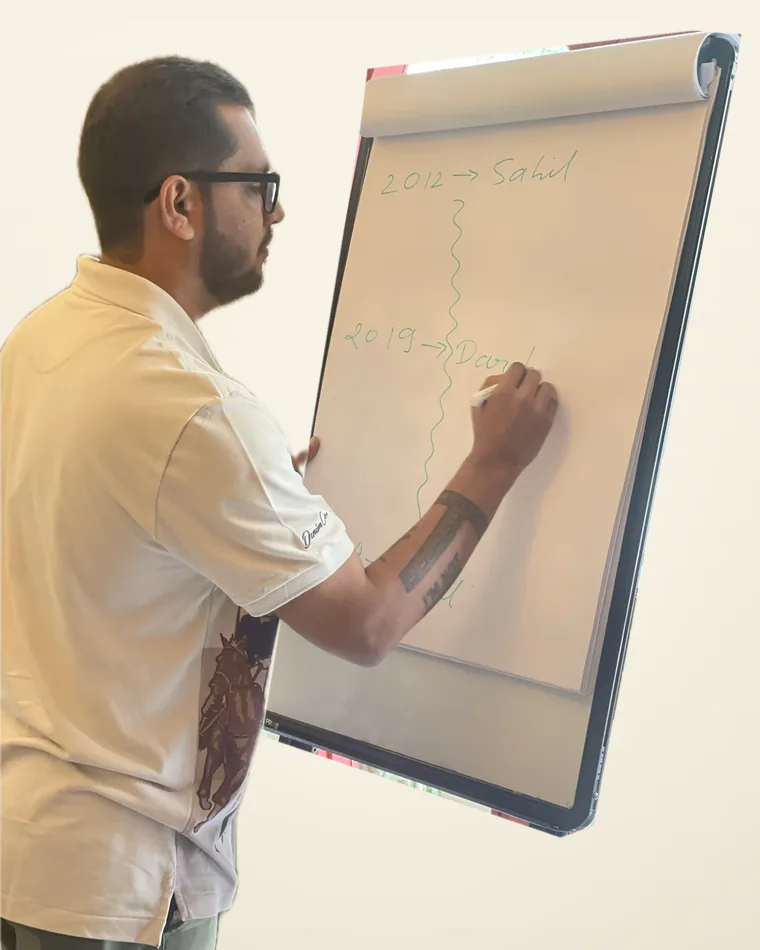
A LinkedIn workshop is a single group session, usually three to six hours, where every participant fixes their own profile, drafts posts and practises messages in the room. We run half-day and full-day workshops on site across India and online. Each ends with finished work, not a slide deck.
What a LinkedIn workshop is, and how it differs from a talk
A talk tells people what to do. A workshop makes them do it before they leave. In our workshops about two thirds of the time is writing and editing on participants' own profiles, and the rest is explanation and discussion. If your event has a stage, a microphone and a question round, you are booking a talk. If it has laptops, pairs and a timer, you are booking a workshop.
The distinction matters for the fee and the outcome. Anyone who has attended a motivational session about personal branding and gone back to an unchanged profile knows the gap between hearing and doing. Talks scale to hundreds of people and change little. Workshops work best at 8 to 40 people, because we can read profiles, and pairs can critique each other. Above that number we recommend splitting the group into two sessions, or adding a second facilitator.
Half-day workshop plan (3.5 hours)
Open and profile snapshot
Each person reads the top of their own profile aloud to a partner. The partner says who they think this person helps.
Headline and About rewrite
Three headline drafts each, tested in pairs, then one About opener written from the reader's side.
Break
Search and keywords
Participants search for the phrase a buyer would use, find themselves or fail to, and edit titles and skills to close the gap.
Post lab
One post drafted from a real work story, hook rewritten twice, peer feedback.
Message practice
Write a connection note and a first message to a real person, then trade with a partner.
Plan and close
Each person writes a 4-week posting plan and one action for tomorrow morning.
Full-day workshop plan (6 hours with lunch)
Open, goals and profile snapshot
Everyone states one outcome they want from LinkedIn.
Profile build
Photo, banner brief, headline, About, Featured, Services. Each section ends with a pair check.
Search, keywords and the Services section
Set up the <a href='/blog/linkedin-services-page-guide'>Services section</a> where it fits and test search results.
Lunch
Content lab
Three post types written and edited: a story, a lesson and a question. Hooks tested against each other.
Conversations
Connection notes, replies to comments, follow-ups, and what to say after someone accepts.
Routine design
A weekly 45-minute routine fitted to each person's diary.
Review and commitments
Pairs swap profiles one last time and agree a check-in date.
Which workshop length fits your group
| Length | Group size | Best for | What it cannot do |
|---|---|---|---|
| 90 minutes | Up to 40, mixed levels | One topic: profiles or posts | Cover both profiles and content in depth |
| Half day (3.5 hours) | 8 to 40 | Teams that need profiles, a first post and message practice | Build a full Services section or a long-term plan |
| Full day (6 hours) | 8 to 30 | Founders, sales teams, leadership groups needing the whole system | Replace follow-up; habits need a few weeks |
| Two half days a week apart | 8 to 30 | Groups that will test things between sessions | Fit a one-day budget or diary |
Fee depends on length, headcount, on site or online, city and travel, and any custom material. Quoted after a 20-minute scoping call or email.
Worked example: choosing a length for a 24-person team
A marketing agency's account managers and designers
The request: 'We want everyone on LinkedIn by next month. One afternoon, whole team, 24 people.'
The plan: a half-day workshop split into two groups of 12, because pairs and profile reading stop working beyond about 15 per facilitator. A 30-minute follow-up call three weeks later, where we review three volunteers' posts.
Room setup and logistics for an on-site workshop
The room decides how much work gets done. Weak wifi, rows of fixed seats and no power points each cost the group time, so we check them before the day. Here is what we ask the host for.
- Seating in clusters of 3 or 4, not in rows. Pairs and trios need to turn to each other.
- A screen or projector and a stable wifi connection. LinkedIn loads slowly on a weak connection, and weak wifi costs the whole group time.
- Power strips. People work on laptops for hours.
- A flip chart or whiteboard for the keyword lists.
- Phones allowed. Profiles are read on phones by most visitors, so we check on phones.
For online workshops we use breakout rooms of three, cameras on while pairs are working, and one shared document where everyone pastes their draft headline for comments.
What participants bring
- A laptop or tablet, plus a phone, both logged in to LinkedIn
- The current CV or bio, in any format
- Two or three real work stories: a problem solved, a project, a client result they are allowed to mention
- A short list of people they want to reach: roles, industries or named companies
- A recent photo, or willingness to take one in the break; see <a href='/blog/linkedin-profile-photo-standards'>profile photo standards</a>
- Permission from their employer on what they may post, which we help the host settle before the day
Worked example: turning a work story into a post
From an operations lead's project note
We implemented a new inventory system across three warehouses and saw improved efficiency.
Three warehouses, one stock sheet nobody trusted. Last quarter we replaced it with a scanner and a shared system. Pickers stopped walking to the office to ask what was in stock. Here is the one rule that made the switch stick.
Numbers that guide how we design the workshop
Workshop or one-to-one training
Workshop
- One date, one room, one shared push
- Peer feedback gives each person 3 or 4 reviewers
- Cost per person falls as the group grows
- Best when a team must start together
One-to-one training
- Fully personal pace and schedule
- Deeper work on one profile and one audience
- Better when the person is senior and short of time
- See <a href='/linkedin-coaching-for-founders'>coaching for founders</a> for ongoing support
When a workshop works, and when it does not
A good fit if
- The group shares an employer, a profession or a goal
- People can open LinkedIn during the session
- A manager or organiser will follow up after the day
- Attendees agree to change their real profile, not a practice one
Not a fit if
- Attendance is compulsory and nobody wants LinkedIn; a different approach is needed, see <a href='/blog/how-to-get-employees-to-post-on-linkedin'>how to get employees to post on LinkedIn</a>
- The goal is a promise of leads or a guaranteed number
- The room has no way to seat people in small clusters
- You want the facilitator to write everyone's profile; choose the <a href='/linkedin-profile-makeover'>makeover</a>
What each participant leaves with
- A new headline and About opener, written and peer-tested
- A keyword list with each phrase placed in headline, About, titles or skills
- One finished post, plus a four-week topic plan
- One connection note and one first message ready to send
- A weekly routine that fits their diary
- A note of three habits to drop
The 90-minute version, when you only have a lunch slot
Snapshot
Partners read each other's first screen and say who the person helps.
One focus: the headline and the first three lines of About
Three drafts, one winner, tested in pairs.
One post
A work story turned into a post with two hook options.
Plan
One action for tomorrow and a date to report back.
What happens before and after the day
Scoping call or email
We settle the goal, headcount, room or platform, and any rules your company has on what people may post.
Profile links collected
Participants send their profile links a few days ahead. We read every one and note the three most common gaps, so the workshop starts on the real problems.
Workshop day
The plan above, adapted to the gaps we found.
Written summary
We send the host a one-page summary of what the group changed and the shared keyword list, so the follow-up has a starting point.
Follow-up call (optional)
A short call a few weeks later where volunteers share posts and we adjust the routine.
Students and colleges, Ahmedabad, and other cities
College groups follow a different plan because students have little work history to describe. That version is on LinkedIn workshop for students. If your event is in Ahmedabad or Gujarat, see LinkedIn training in Ahmedabad. For a pricing overview, read how pricing works.
On video
Watch it explained
Videos from our founder’s YouTube channel. Each one loads only when you press play.


On LinkedIn
What our founder has posted about this
 Bhavik SarkhediPost on LinkedIn
𝘠𝘰𝘶𝘳 𝘧𝘶𝘵𝘶𝘳𝘦 𝘤𝘭𝘪𝘦𝘯𝘵𝘴 𝘢𝘳𝘦 𝘴𝘵𝘢𝘭𝘬𝘪𝘯𝘨 𝘺𝘰𝘶𝘳 𝘱𝘳𝘰𝘧𝘪𝘭𝘦 𝘸𝘩𝘪𝘭𝘦 𝘺𝘰𝘶'𝘳𝘦 𝘣𝘶𝘴𝘺 𝘰𝘷𝘦𝘳𝘵𝘩𝘪𝘯𝘬𝘪𝘯𝘨 𝘺𝘰𝘶𝘳 𝘯𝘦𝘹𝘵 𝘱𝘰𝘴𝘵. 𝘗𝘰𝘴𝘵 𝘢𝘯𝘺𝘸𝘢𝘺. 𝘚𝘩𝘰𝘸 𝘶𝘱 𝘮𝘦𝘴𝘴𝘺 𝘪𝘧 𝘺𝘰𝘶 𝘮𝘶𝘴𝘵. 𝘚𝘩𝘰𝘸𝘪𝘯𝘨 𝘶𝘱 𝘣𝘦𝘢𝘵𝘴 𝘱𝘦𝘳𝘧𝘦𝘤𝘵𝘪𝘰𝘯. HOW TO OPTIMIZE YOUR LINKEDIN PROFILE (PRACTICAL, NON-BORING) 1...
From our founder's LinkedIn: a practical profile checklist, the base for the first block of the workshop.
Bhavik SarkhediPost on LinkedInHow do viral LinkedIn posts really work? It’s not luck, it’s a system, and it all comes down to the Pyramid of Impact. Foundation: Start with personalization, rawness, and storytelling. Write like you’re speaking to one person...
How posts that travel are built, used in the post lab.
Proof
What clients say on LinkedIn
Every quote is copied from a public LinkedIn recommendation or review. Click through to read the full text.
Average of 9 reviews left on our founder’s LinkedIn services page.
Each review below is quoted as written.
“Bhavik listens deeply, challenges assumptions when needed, and pushes ideas forward with precision and empathy.”
“My business experienced an incredible 400% growth as a direct result of his work.”
“He crafts narratives that don't follow trends, they set them.”
“His knowledge about SEO is so in-depth! He really brings great value to the table.”
“He has a rare ability to simplify digital marketing and branding into clear, actionable strategies that deliver real results.”
“His creative approach and dedication to quality content are unmatched.”
“He deeply understands the core principles of branding, ensuring content quality rather than publishing merely for quantity.”
“He knows how to position you in a way that feels authentic but still commands attention.”
“Bhavik helped me improve my personal brand by showing me how to highlight my skills and values clearly.”
“He has a rare ability to simplify digital marketing and branding into clear, actionable strategies that deliver real results.”
“His knowledge about SEO is so in-depth! He really brings great value to the table.”
Questions people ask
What is a LinkedIn workshop?
A LinkedIn workshop is a group session where each participant improves their own profile, writes posts and practises messages in the room. Ours run from 90 minutes to a full day, on site across India or online, and finish with a written plan for the next four weeks.
How long should a LinkedIn workshop be?
Pick by outcome. 90 minutes handles one topic. A half day of about 3.5 hours covers profile, search, a first post and message practice. A full day of about six hours adds the Services section, a content lab and routine design for the whole system.
How many people can attend a workshop?
We work best with 8 to 40 people on site. Above 15 per facilitator the individual feedback shrinks, so we split larger groups into two sessions. Online we cap breakouts at three people so everyone speaks.
What do participants need to bring?
A laptop and a phone logged into LinkedIn, a current CV or bio, two or three real work stories they can share, and a list of people they want to reach. Employer rules on posting should be settled before the day.
Can the workshop be held online?
Yes. Online workshops use breakout rooms of three, a shared document for draft headlines and cameras on during pair work. The agenda is the same, with slightly longer breaks. Groups that want hands-on profile fixing side by side usually prefer the room.
How much does a LinkedIn workshop cost?
The fee is on request after a 20-minute scoping call or email. It depends on length, headcount, on site or online, city and travel, and custom material. For context, one chamber of commerce sold a six-hour seat at about Rs 2,500 to 3,000.
Do you follow up after the workshop?
We suggest a short follow-up call a few weeks later, where volunteers share posts and we adjust the routine. It is optional and scoped in the quote. Without a follow-up date, posting habits usually fade within the first fortnight.
Is a workshop better than recorded lessons?
It depends on the group. A workshop forces everyone to do the work on one day and gives live feedback. Recorded lessons are cheaper and self-paced but rely on each person finishing, and completion is where they usually fail. Many teams run a workshop first and use recorded material as reference.
Sources we used
- Bombay Chamber of Commerce, Personal branding on LinkedIn for your team workshop: bombaychamber.com
- Semrush, We Analyzed 89K LinkedIn URLs Cited in AI Search: semrush.com
- Adgully, LinkedIn India crosses 100 million members milestone: archive.adgully.com
Keep going
Related pages
LinkedIn Training for Professionals and Small Groups
Live LinkedIn training by LinkedIn Buddy: four modules on profile, search, content and messages, for individuals and small groups, on site or online.
Read →For companiesCorporate LinkedIn Training for Teams, Built Around Your Brief
Corporate LinkedIn training for HR and L&D heads: pre-work audit, workshop, posting policy, 30-day follow-up and measurement, from LinkedIn Buddy.
Read →Ahmedabad and GujaratLinkedIn Training in Ahmedabad for Companies and Colleges
LinkedIn training in Ahmedabad by a local trainer: on-site workshops for Gujarat companies, colleges and associations, in English or Gujarati-English.
Read →Profile makeoverLinkedIn Profile Makeover Service: We Write, You Approve
Done-for-you LinkedIn profile makeover by LinkedIn Buddy: headline, About, experience, Featured, Services and banner brief, with examples.
Read →Book a LinkedIn workshop
Write to us with the headcount, the city and whether you prefer on site or online. We reply with a length and a scoping call time.